
What Stuck: "A History of Violence"
Rewatch notes that didn't make Tuesday's essay — the two break-ins, the performance, and the door Edie won't open.

Every Thursday I go back through Tuesday's essay and pull out what stuck — the observations and details that didn't make the final cut but wouldn't leave me alone. Here's what stuck from this week's piece.
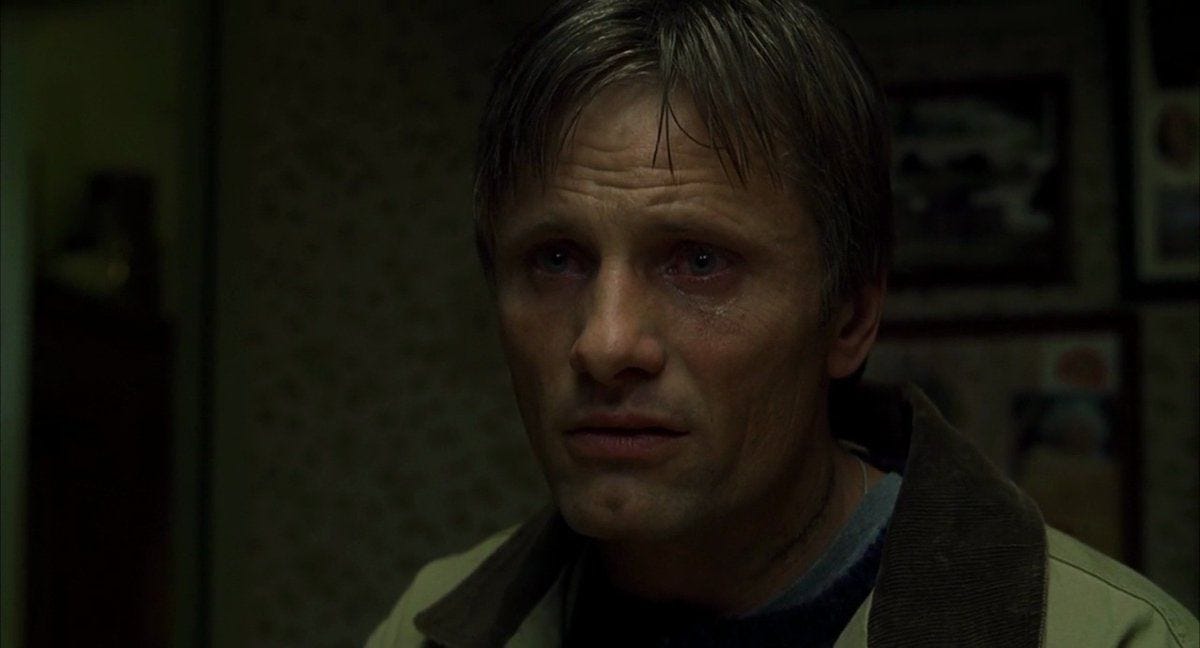
The two break-ins
The whole movie is really just the outside world coming through the front door twice — first the drifters, then the Philly mob — and each time it turns out the nice quiet life was never actually self-made. It was always sitting on top of something.
It doesn’t even open on the family. It opens on two guys living out of a car, and before they’re anywhere near Tom’s diner they’ve killed a motel clerk, a maid, and a child. A dad, a mom, a kid. They wipe out a little family unit before the story technically starts.
You hear them before you see them. Cronenberg lays this wall of insect noise under the opening — buzzing, chittering, the works — and the message is basically: these men come from nature. Not the town, not civilization. The lawless part underneath, where the soundtrack is a million bugs.
Everybody’s already faking it
Cut from that straight to the Stall house, where the little daughter’s screaming from a nightmare and Tom tells her “there’s no such thing as monsters.” Which is true! And also completely useless, because the monsters in this movie are real and about four scenes away.
Here’s the part I think gets missed: Tom’s life is already a performance before a single violent thing happens to him. The drive-in joke, the fumbled baseball advice, wiping down the diner — he’s running a “wholesome American dad” bit he clearly absorbed from TV.
And the quotation marks around all of it aren’t just Cronenberg’s. They’re Tom’s. He built the whole life out of what movies told him a good life looks like. Which honestly tells you everything you need to know before Joey Cusack ever surfaces.
Even the kid. Jack takes his bully apart with words instead of fists and you want to read him as the evolved one — but he’s still doing aggression, he’s just picked the ground where he wins. Not different from the bully. More repressed. Not the same thing, and the movie knows the difference.
Edie in denial, in real time
When the mob guys show up, Edie calls them “reporters.” Twice. A black sedan, sunglasses indoors, one of them in a suit that looks beamed in from 1987 — these men could not read less like press. She’s not confused. You’re watching denial do its job.
What finally cracks it is a throwaway line: one of them jokes they should clear out before Tom gets mad. That’s the thing that makes her look up. First time she’s heard what Tom did at the diner framed as anything but heroic, and something about the knowingness of it gets through.
And then the thing I actually wrote about
All of that is setup for the person the movie’s really about. Once Edie can see it — the whole ugly foundation the nice life was resting on — the film drops one question in her lap and cuts to black. Doesn’t answer it. Won’t.
That question, the one she’s really praying over at the last dinner table, is what I couldn’t stop turning over, so I wrote the whole piece about it — what the movie makes her carry, and then quietly makes us carry too.