
The Question “A History of Violence” Refuses to Answer
Can we stomach peace and comfort once we know their true cost?

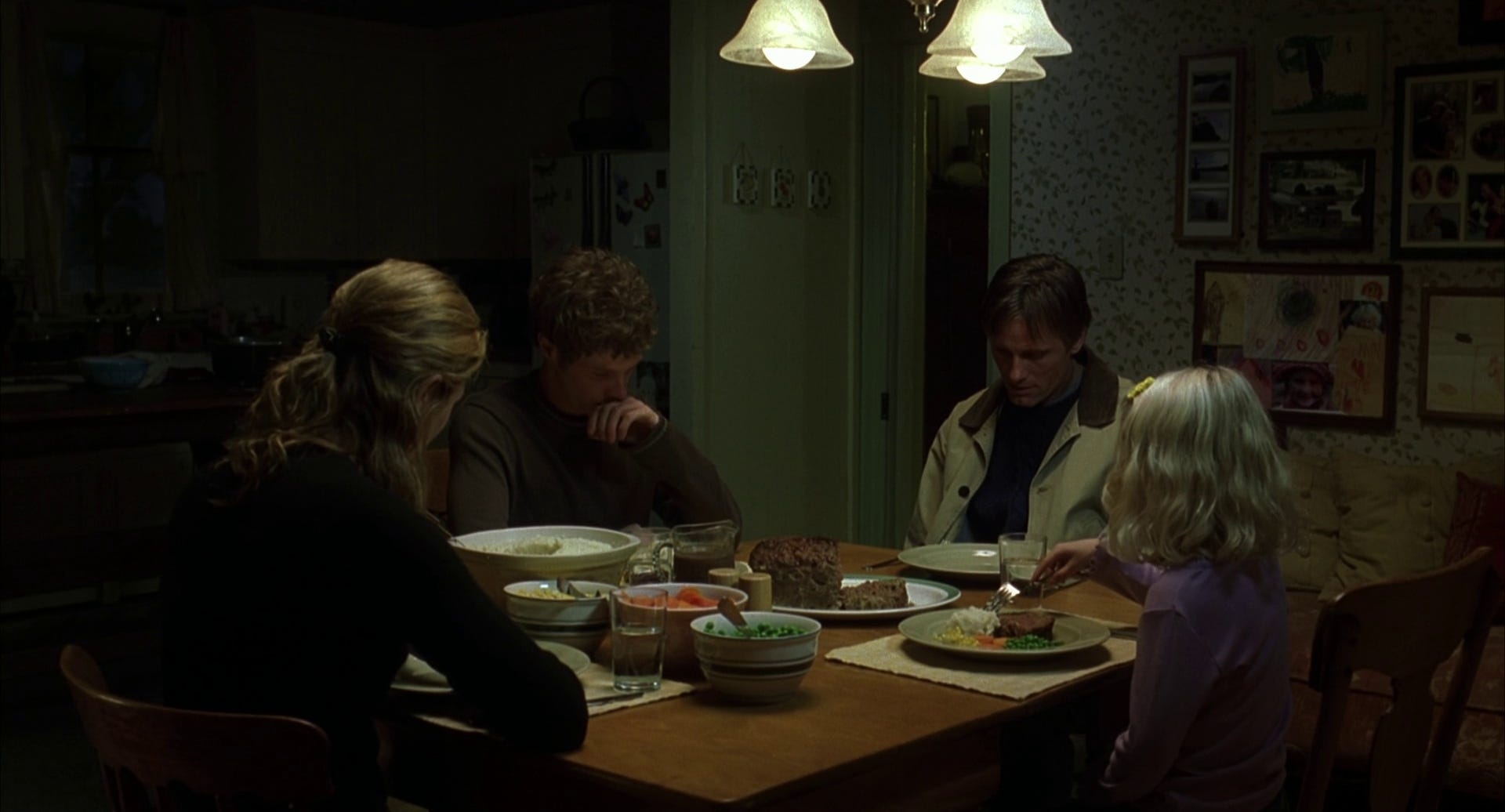
In the last scene of A History of Violence, a wife must decide whether she can look her husband in the face without wanting to retch.
Edie Stall (Maria Bello) sits at the dinner table with her head bowed and her hands folded, and if you didn’t know better you’d think she was saying grace. Played by Viggo Mortensen, the man across the table — a split personality who she’s always known as mild-mannered Tom Stall, but who has revealed himself to be a former mafia hitman by the name of Joey Cusack — has just come home from killing at least four men, including his own brother. Tom and Edie’s youngest, Sarah, too small to know why the dinner has gone silent, sets her father’s plate at his usual spot. Wordlessly, their teenage son Jack (Ashton Holmes) puts a plate of meatloaf next to his father.
David Cronenberg’s 2005 film is remembered for its flashes of visceral mayhem, but its real subject is Edie, who must decide whether she can go on living in peace and comfort now that she has seen the violence it takes to secure them. Adapted by Josh Olson from the graphic novel by John Wagner and Vince Locke, A History of Violence begins as a private matter — one wife, one marriage, one small Indiana town — before revealing itself to be about something much larger, and much harder for the viewer to disown.
Cronenberg has called himself “a complete Darwinian,” and in his review of the film, Roger Ebert took him at his word. The movie, Ebert argued, is about survival of the fittest, “not the good, the moral, the nice, but the fittest.” And when two itinerant serial killers descend on Tom’s small-town diner looking for blood and a quick score, it’s Joey, the sadistic murderer, and not Tom, the decent family man, who displays with shocking clarity what “survival of the fittest” can really mean.
Yet even if this “Darwinian” interpretation of life is the engine of the film, I think it’s merely the beginning — and not the endpoint — of the conversation Cronenberg wants to inspire. Yes, life is red in tooth and claw; and all those who survive today are the descendants, however distant, of people who did things in the past for their own survival that would make their genetic inheritors blush. To Cronenberg, that’s a given.
What’s more interesting to him is how we, as individuals and as societies, take that stubborn and ugly truth about survival and either repress it or transmute it into something we find more palatable. What happens when the facts before us are so severe, so ugly, and so undeniable that they threaten to overwhelm our capacity to rationalize and accept? What happens when the product of the “survival of the fittest” isn’t an abstraction but a real-life man, covered in the blood of those he’s just maimed and pulverized, standing before us and asking again for the love and comfort we once gave so freely?
That’s the question that has Edie praying over her meatloaf in the film’s final scene. It’s a question that, ultimately, only she can answer. But it’s a question that, in some form or another, and whether we want to admit it or not, structures the life of anyone lucky enough to be born into comfort and peace.
Consider what went down that terrible night in Tom’s little diner, and then think about how, according to the film, the wider community digests it. Tom breaks a coffeepot over one robber’s face, shoots the other, and then, after being stabbed in the foot by the man whose face he’s mangled, delivers a killing gunshot to his first target. And for perhaps two seconds it is thrilling, because the men are vile and a waitress is about to be raped. Then the thrill curdles. Where the director of a traditional thriller would look away, Cronenberg holds: on the waitress, sobbing; on the mangled flesh and death-gurgles of the first attacker; on Tom, clutching the gun and looking as sick as anyone in the room.
Tom hasn’t done anything wrong. But it would be absurd to say that, in that diner, at that moment, anyone is feeling “saved.”
And yet, within a day, everyone who wasn’t there has decided that what Tom did was magnificent. The half-empty diner fills with locals who want their eggs served where the shooting happened. A newscaster calls him a hero. His son grabs his arm and crows, “You’re a hero, Dad!” And when Tom asks his wife if she’s as sick of hearing about it as he is, Edie says, “No. I kind of like it,” and reveals the day’s newspaper so Tom can see his own face on the front page.
The one man who actually did the killing is the only one still insisting it was terrible. Everyone else has moved on to stories of heroes and adventure. But before you blame the people of Millbrook too harshly, ask yourself: Wasn’t there some part of you, too, that cheered when Tom sprang into violent action? Didn’t some part of you want to see these murderous rapists put down for good? Now imagine that was your husband.
It is Edie who, earlier in the film, in happier times, dreams up some sexual roleplay for her and Tom: a chance for them to be “teenagers together,” something, she says, the two of them never got to experience. After they have finished with what must be one of the tenderest depictions of mutual oral sex in the history of cinema, Edie takes Tom’s face in her hands and tells him: “You’re the best man I’ve ever known.” Not the best person, the best man.
But it’s during the film’s second sex scene, the masterfully complex “stairwell scene,” that we witness the fantasy of Edie and Tom’s bond congeal into something more complicated, more violent, and more real. After insisting on Tom’s false identity to a newly skeptical sheriff — “Hasn’t this family suffered enough?” she asks — Edie once again rejects Tom the moment the lawman leaves. She pushes him away, her disgust and betrayal visible in her eyes, and attempts to flee the living room by ascending a nearby staircase. Tom pulls at her, desperate for her to understand him, to forgive him, to once again love him — but she lashes out, kicking and hitting him as she tries to get away.
Seemingly triggered into action by Edie’s violence, Joey takes over Tom, and for a horrifying moment it looks as though the fight on the staircase is about to become a rape. And then, at the last second, right when he’s on top of her, Tom regains control of himself and begins to stop and turn away. It’s at this crucial juncture that Edie reaches up, grabs Tom by the hair, and pulls him back down toward her. The sex that follows is animalistic, furious, and hard to distinguish from violence. But it is also, unquestionably, sex that some part of Edie — perhaps the part of her that was excited and proud when she heard about what Tom did that night at the diner — wants to have.
As soon as it’s over, though, and both Edie and Tom return to “themselves” — a concept the film is increasingly problematizing — Edie’s contempt for Tom returns. Notably, throughout their stairwell fuck, Edie has kept her eyes closed. Once it’s over and she has to look at Tom again, she cannot get away from him quickly enough. He seems to want to cuddle, under the impression that they’ve just reconciled. She pushes his face away with evident disgust, gets up, scampers back up the stairs, and immediately takes a shower. One wonders whether, in the first moment when she locks eyes with Tom in that stairwell, Edie can hear the question about her husband that one of Joey’s pursuers, Carl Fogarty (Ed Harris), has planted in her head like a poisoned seed: “Ask him how come he’s so good at killing people.”
“There is no document of civilization,” Walter Benjamin wrote, “that is not at the same time a document of barbarism.” The good coffee and the front-page hero and the sleeping child who has been promised there are no monsters all sit on top of the barbarism that keeps them safe, and the price of keeping the document intact is that you never turn it over. But what happened at the diner, and the revelations that followed, did not just turn that document over; it made that hideous underside the only thing Edie could see.
During the film’s final scene, as she readies herself to make eye contact with Tom one more time, one wonders who is more terrified of what she’ll find: Edie, Tom, or the audience. That, of course, is when Cronenberg cuts to black.