

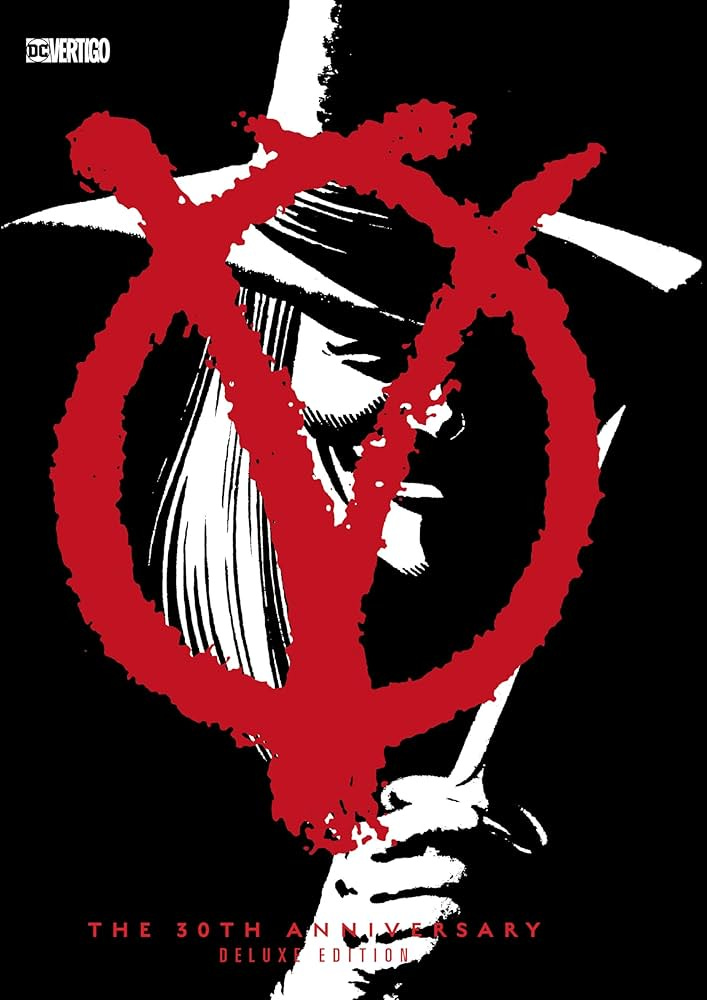
I read V for Vendetta for the first time recently. I’m already an enormous admirer of Watchmen, and I loved From Hell. If I have to choose one, I’m still sticking with Dr. Manhattan; but Vendetta might be my new second-favorite of Moore’s work.1
(Please consider this your spoiler alert if you haven’t read the comics yet.)
That said, I am hardly an expert on comics as a medium. But I am a guy with a Substack, so I can at least do this much: Tell you what about V for Vendetta has stuck with me in the time since I read it, and offer you a theory about why I found the story so resonant during the particular moment in which I experienced it.
What stuck with me about Vendetta is how principled it is. And I don’t mean that in the sense that it presents a theory of the world — and/or a program for how to fix it — and then delivers on that promise.
That would be a kind of principled certainty. But the principle I see and admire in the work is quite the opposite. What makes Vendetta so compelling is not that it presents final answers; it’s that it not only defends — but actually embodies, through its storytelling — a principle of relentless uncertainty and doubt.
Here’s what I mean: Alan Moore is an anarchist. And I don’t mean that in a figurative sense. I’m not saying he doesn’t play by other people’s rules or something similarly cheap and hollow.
I mean, instead, that Alan Moore is someone who has thought deeply about politics and concluded that the only ideology that makes sense to him — the only ideology that can be defended as something more than new branding for the same-old ideas of domination and control — is anarchism.
“In diversity, there is strength”
From an interview with Margaret Killjoy:
Way back in the early 80s, when I was first kicking off writing V for Vendetta … the story was very much a result of me actually sitting down and thinking about what the real extreme poles of politics were. Because it struck me that simple capitalism and communism were not the two poles around which the whole of political thinking revolved. It struck me that two much more representative extremes were to be found in fascism and anarchy.
Here’s how Moore defines fascism:
Fascism is a complete abdication of personal responsibility. You are surrendering all responsibility for your own actions to the state on the belief that in unity there is strength, which was the definition of fascism represented by the original roman symbol of the bundle of bound twigs. Yes, it is a very persuasive argument: “In unity there is strength.” But inevitably people tend to come to a conclusion that the bundle of bound twigs will be much stronger if all the twigs are of a uniform size and shape, that there aren’t any oddly shaped or bent twigs that are disturbing the bundle. So it goes from “in unity there is strength” to “in uniformity there is strength” and from there it proceeds to the excesses of fascism as we’ve seen them exercised throughout the 20th century and into the 21st.
And here’s how he contrasts that with anarchy:
Now anarchy, on the other hand, is almost starting from the principle that “in diversity, there is strength,” which makes much more sense from the point of view of looking at the natural world. Nature, and the forces of evolution … did not really see fit to follow that “in unity and in uniformity there is strength” idea. If you want to talk about successful species, then you’re talking about bats and beetles; there are thousands of different varieties of different bat and beetle … The whole program of evolution seems to be to diversify, because in diversity there is strength. And if you apply that on a social level, then you get something like anarchy.
In V for Vendetta, V — the “hero,” for lack of a better word — is not just an anarchist. He is, like, the ultimate anarchist. He is to anarchism what Michael Jordan was to basketball. He’s smarter than everyone, faster than everyone, stronger than everyone, and always a step ahead. If you didn’t know better, you’d think he was a superhero.
Moreover, the “Norsefire” government V is fighting — which seems to be in control of most, but not all, of the former UK — is a fascist totalitarian dictatorship.
It rounds-up people because of their race or religion or sexual orientation, and then it murders them in concentration camps. It’s a police-state panopticon whose agents are sadistically violent and shamelessly corrupt. Its religious figurehead is a pedophile. Its “Leader” is a self-hating recluse who routinely threatens subordinates with death.
The situation that Moore has created, in other words, could hardly be more perfectly suited for the heroic intervention of V, his cape-wearing super-anarchist. And in other, lesser hands, V for Vendetta would end up as a kind of anarchist equivalent to Top Gun or Red Dawn. A counter-culture-coded version of what is, fundamentally, propaganda and kitsch.
But that’s not what Moore gives us. While he doesn’t deny us the thrill of seeing V kill the fascists trying to stop him — or the spectacle of watching V blow up Parliament as a combined homage to Guy Fawkes and declaration of war against Norsefire — he also doesn’t let us kid ourselves about what we are watching.
Because what we are watching, what we are cheering for, are the actions of a terrorist and unrepentant murderer who has decided — regardless of anyone else’s wishes — that he not only has the desire but the right to watch the world burn.
This isn’t just my read. Here’s what Moore says, in the interview I shared above, about the idea of violent revolution:
I don’t believe that a violent revolution is ever going to work, simply on the grounds that it never has in the past. I mean, speaking as a resident of Northampton, during the English civil war we backed Cromwell—we provided all the boots for his army—and we were a center of antiroyalist sentiment … Cromwell’s revolution? I guess it succeeded. The king was beheaded … But give it another ten years; as it turned out, Cromwell himself was a monster. He was every bit the monster that Charles I had been. In some ways he was worse. When Cromwell died, the restoration happened … And the status quo was restored. I really don’t think that a violent revolution is ever going to provide a long-term solution to the problems of the ordinary person. I think that is something that we had best handle ourselves…
Take a beat to appreciate how complex and rigorous this is.
The “hero” we’re rooting for throughout V for Vendetta — and, make no mistake, we are always rooting for V, even if we’re increasingly uncomfortable with his methods; there’s no question that Norsefire is an evil regime that “deserves” to be destroyed — is someone who is enacting a program that Moore himself does not believe will work.2
But as that quote above shows, Moore doesn’t argue that it won’t work because he subscribes to some version of the sentimental liberal idea that violence is always wrong.
He’s saying it won’t work because it never has — at least not if you define “work” as in “creates a political order that is better, more humane, more just than the one that came before” rather than defining it down as, well, “we wanted to cut off the king’s head, and we did it; so it worked!”
And, to be fair, V is too smart — and too complex a character — to be ignorant of this. He never promises that what he’s doing will usher in some golden age. He never says that all he needs to do is break the chains of oppression, to tear down the walls of the panopticon, and that individual freedom will flourish in the absence of dictatorial control.
What he does, instead, during what is definitely my favorite part of the whole series, is take the mirror, as it were, and direct it back at the people themselves. He doesn’t say: You’re now free. Go enjoy it! He says, I am giving you the opportunity to decide if you want to be free. This is a test. Will you fail it?
This moment comes a little more than halfway through the story. V has commandeered Norsefire’s television broadcast studio and is speaking directly to the people. He has already blown up a lot of the regime’s power-centers, as well as murdered many of the regime’s power-players. Now he’s finally speaking, directly, to the people.
And rather than provide some kind of rhapsodic defense of anarchism that paints a beautiful picture of the utopia that’s right there if they’ll just take it, he takes his audience to task for — as Moore describes the essence of fascism in the quote above — their willingness to live under a regime that represents “is a complete abdication of personal responsibility.”
Here’s the key moment from the graphic novel — the speech he delivers as Norsefire’s security services desperately try to retake control of the broadcast and kill V — but I’ll also provide the raw text of his speech below in case these screen-grabs are hard to see:
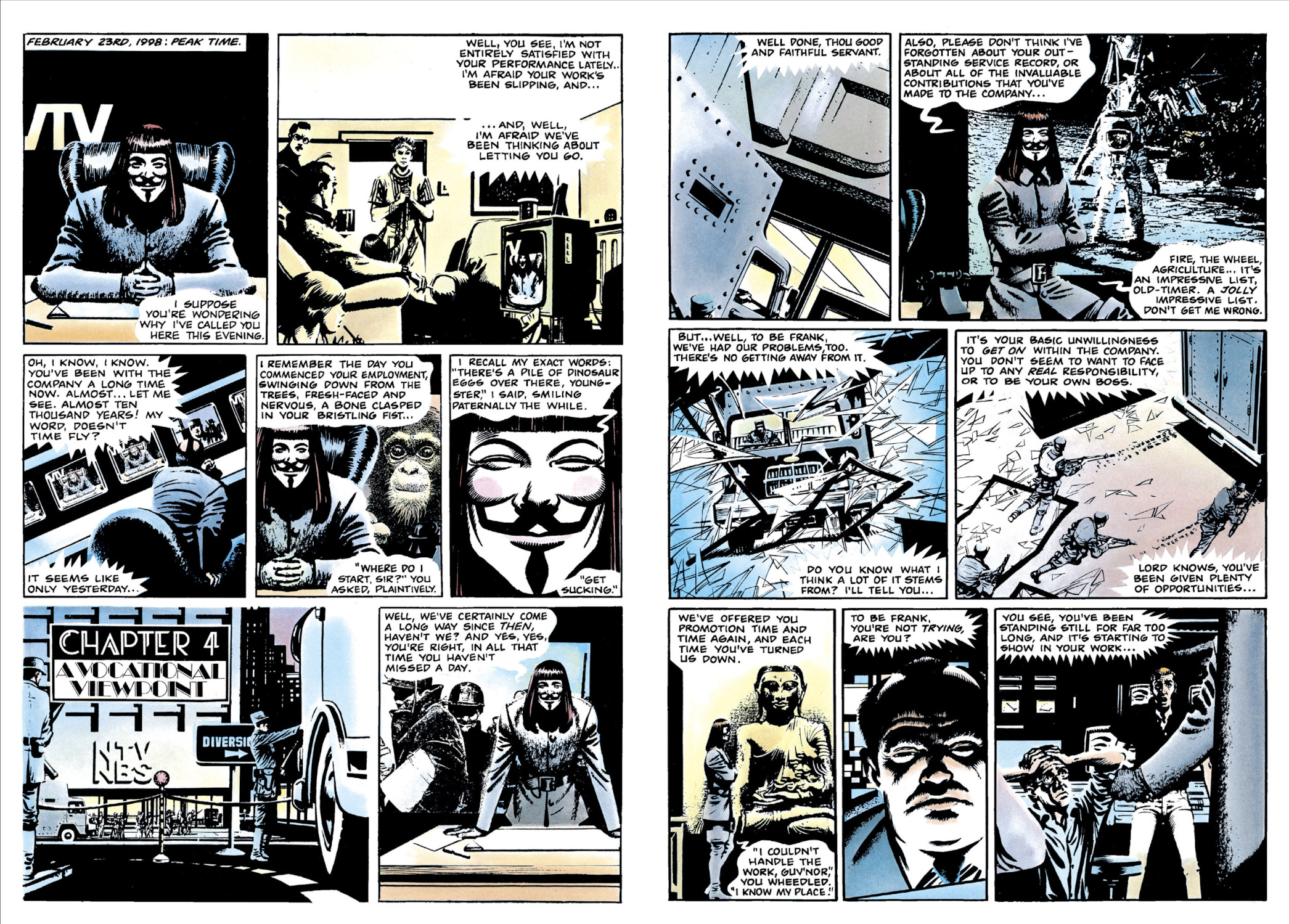
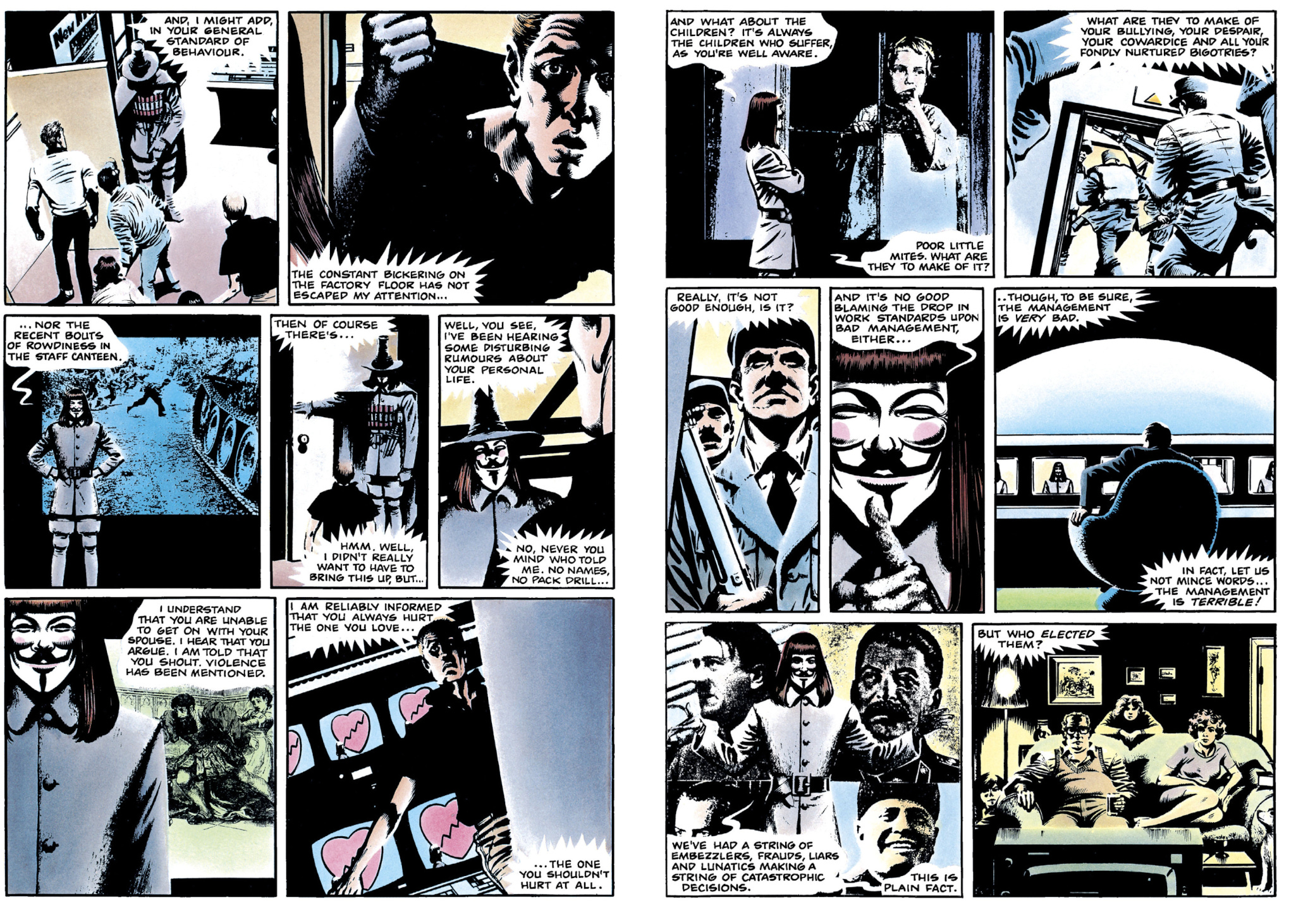
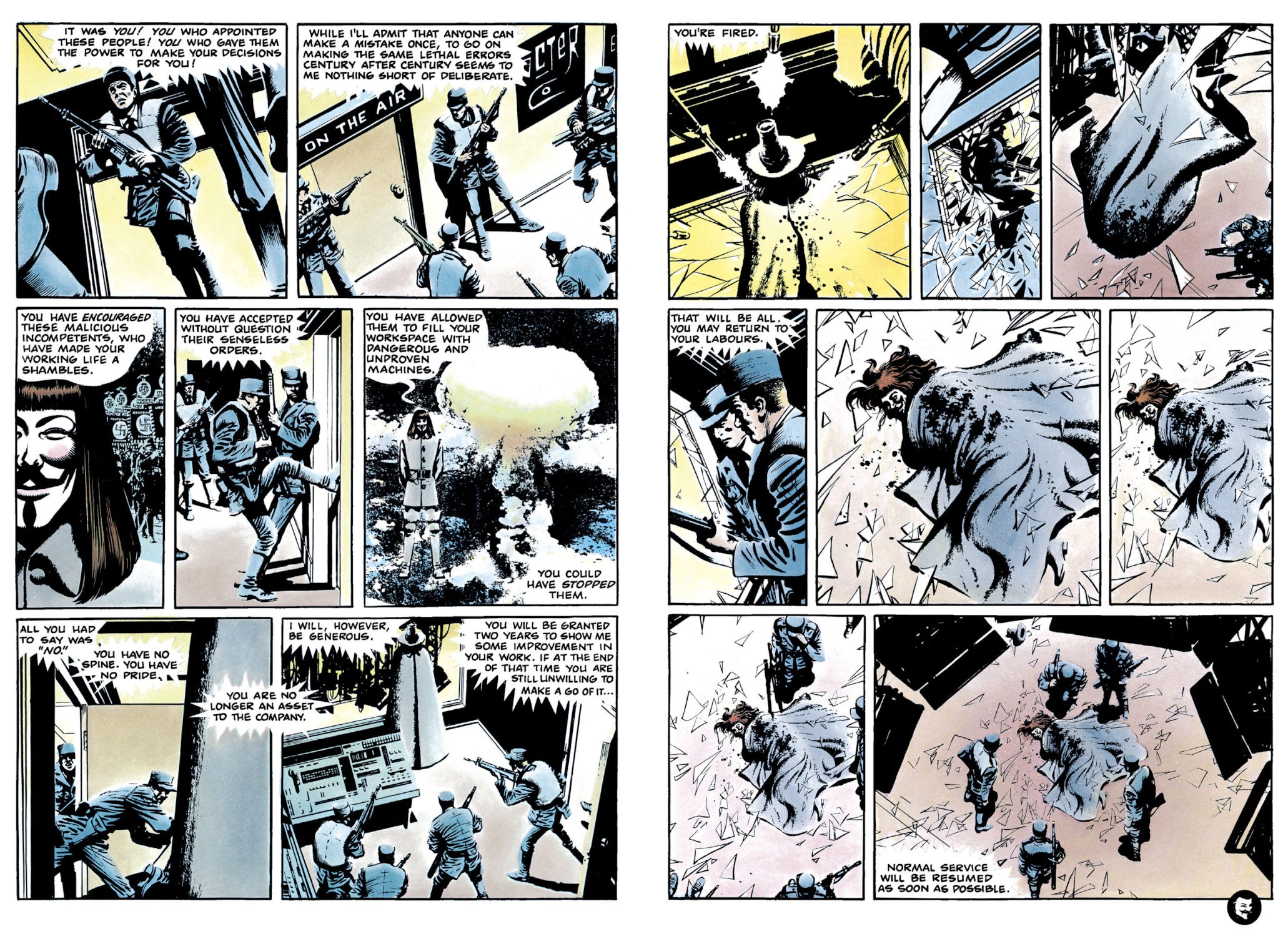
And here’s the speech (with light edits on my part):
Good evening, London. I thought it time we had a little talk. Are you sitting comfortably? Then I’ll begin…
I suppose you’re wondering why I’ve called you here this evening. Well, you see, I’m not entirely satisfied with your performance lately…I’m afraid your work’s been slipping, and…and, well, I’m afraid we’ve been thinking about letting you go.
[…]
Do you know what I think it stems from? I’ll tell you: It’s your basic unwillingness to get on within the company. You don’t seem to want to face up to any real responsibility, or to be your own boss. Lord knows, you’ve been given plenty of opportunities…
We’ve offered you promotion time and time again, and each time you’ve turned us down. “I couldn’t handle the work, Guv’nor,” you wheedled. “I know my place.” To be frank, you’re not trying, are you?
[…]
And it’s no good blaming the drop in work standards upon bad management, either…though, to be sure, the management is very bad. In fact, let us not mince words…the management is terrible! We’ve had a string of embezzlers, frauds, liars, and lunatics making a string of catastrophic decisions. This is plain fact.
But who elected them?
It was you! You who appointed these people! You who gave them the power to make decisions for you! While I’ll admit that anyone can make a mistake once, to go on making the same lethal errors century after century seems to me nothing short of deliberate.
You have encouraged these malicious incompetents, who have made your working life a shambles. You have accepted without question their senseless orders. You have allowed them to fill your workspace with dangerous and unproven machines.
You could have stopped them. All you had to say was “no.” You have no spine. You have no pride. You are no longer an asset to the company.
I will, however, be generous. You will be granted two years to show some improvement in your work. If at the end of that time you are still unwilling to make a go of it… you’re fired.
That will be all. You may return to your labours. Normal service will be resumed as soon as possible.
That last part — the line about how the people will be “granted two years to show some improvement” that is key, and that is the essence of my argument that what makes V for Vendetta so compelling is that it denies us resolution, that it forces us to live in uncertainty.
Because, by the end of the story, while it certainly seems clear that Norsefire is kaput, the question of whether the people will “show some improvement” — whether they will take the opportunity V has given them by creating an opening where once there was an iron wall — remains profoundly in doubt.
As the government collapses and the people begin to riot, V says:
Anarchy means “without leaders”, not “without order”. With anarchy comes an age or ordnung, of true order, which is to say voluntary order... this age […] will begin when the mad and incoherent cycle of verwirrung that these bulletins reveal has run its course... This is not anarchy […] This is chaos.
And, indeed, the final image we see in the comic of the liberated people is not exactly encouraging:
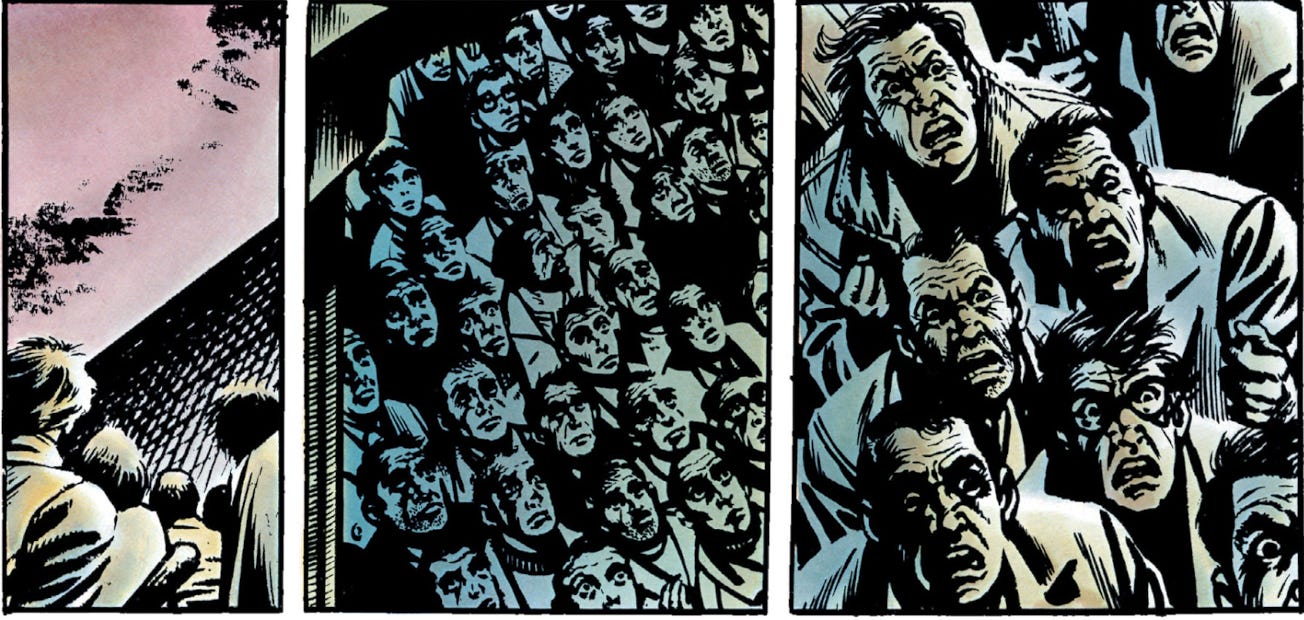
Will people choose true freedom, true “personal responsibility,” true agency? Or will they allow themselves to degenerate into an orgy of violence and looting until, inevitably, some new strongman — some new would-be Leviathan — arrives to promise peace and order in exchange for total submission?
Moore leaves it as an open question. It is, to my mind, an incredibly principled and even somewhat brave choice. He is denying himself — and us — the easy answer. He is foregoing the serene and complacent confidence that the human spirit yearns for freedom that would make the viability of anarchism seem so compelling, so self-evident.
In his way, he is choosing “personal responsibility” — the responsibility of the artist to tell the truth as best they can understand it, rather than to tell comforting fictions, especially self-comforting fictions — through his storytelling.
That is what I mean when I say that V for Vendetta doesn’t simply tell us we should live in doubt and with the burden of responsibility; it shows us how to do that through its own narrative choices. These are the principled choices it makes that I admire so deeply.
Do we “look to be ruled”?
I promised that I’d do my best to explain what I found so inspiring and powerful about V for Vendetta on its own terms and simply as a piece of art. But I also said I’d try to offer a theory as to why I found it, at this particular moment, so resonant.
Well, simply put, I think it’s because in many places across the world today, but certainly and most crucially in the United States, the question of whether people actually want to be free — free in the sense that V means, in the sense that Moore means — is very much to be determined.
We are living through an era of revenant strongman politics. And we have spent much of the last 10 years searching for explanations — often materialist explanations, answers having to do with economic anxiety or rising interest rates or unaffordable housing or skyrocketing healthcare costs, and so on — that allow us to avoid a more uncomfortable possibility.
That possibility, in a nutshell, is that when then-President Barack Obama said this during the 2016 Democratic National Convention, he was wrong (emphasis mine):
Ronald Reagan called America “a shining city on a hill.” Donald Trump calls it “a divided crime scene” that only he can fix. It doesn’t matter to him that illegal immigration and the crime rate are as low as they’ve been in decades — because he’s not actually offering any real solutions to those issues. He’s just offering slogans, and he’s offering fear. He’s betting that if he scares enough people, he might score just enough votes to win this election.
And that’s another bet that Donald Trump will lose. And the reason he’ll lose it is because he’s selling the American people short. We’re not a fragile people. We’re not a frightful people. Our power doesn’t come from some self-declared savior promising that he alone can restore order as long as we do things his way. We don’t look to be ruled. Our power comes from those immortal declarations first put to paper right here in Philadelphia all those years ago: We hold these truths to be self-evident, that all men are created equal; that We the People, can form a more perfect union.
That’s who we are. That’s our birthright — the capacity to shape our own destiny.
It would not be an exaggeration to say that, for nearly 10 years, this quote has haunted me. I remember hearing it in real-time and thinking: “God, I hope he’s right.” I still do.
But I remain profoundly uncertain. Taking responsibility on this level is a heavy lift. It’s always tempting to think the problem, to paraphrase V, can be solved through a simple “change in management.”
Yet when I worry that somehow, someway, we’ve passed the point of no-return — that we have definitively proven ourselves incapable of recognizing that the world is what we make of it — I also take solace in another classic line from Moore, this time from Watchmen:
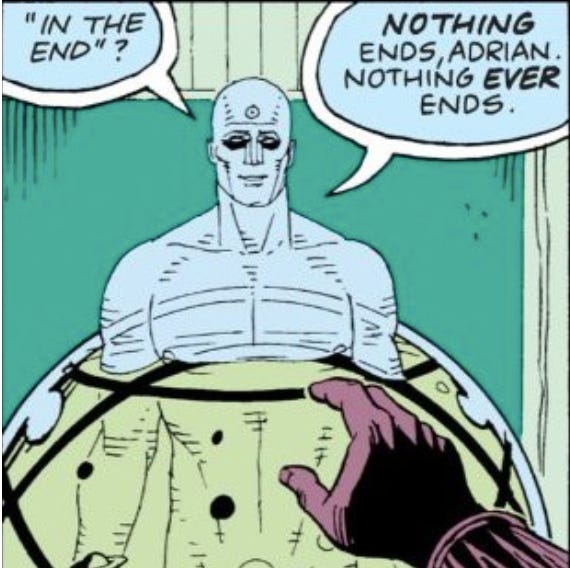
“Nothing ever ends.”
The week in posts
This is a new feature I’m trying out. Let’s see if y’all dig it.
Basically, I spend too much time on Bluesky. And sometimes I do posts on Bluesky that I think are — well, if not good, then at least not bad.
Sometimes I take those posts and I build them out into larger arguments or essays. But sometimes, I think, I’ve basically said what I wanted to say and there’s no need for further elaboration.
So, with all that in mind, and realizing that many of you are sane and therefore not using Bluesky on the regular, I’ve decided I’m going to share some of my posts here.
I think you’ll notice a theme…
Watch out for this Alan Moore guy — he’s going places!
To quote Rivers Cuomo, “How cool is that!”
V is a fascinating character. He also represents Culture, from Shakespeare to Martha & the Vandellas. This is in opposition to fascist art, which is typified by military marches and idiotic, raunchy sitcoms. It’s a conflict between the the authentically and freely human on the one hand, and deadening conformity on the other.
Also, his emphasis on individual freedom and responsibility is in tension with how he brutally forces Evey to endure the same trauma that created him, which liberates and transfigures her. Yet after her transformation she refuses to authorize V to kill the man who murdered her lover. She becomes a V who is fit for a better world. “The age of killers is no more. They have no place within our better world.”