
Why Sam Altman reminds me of Anton Chigurh
To understand what the people building AI are really saying, it helps to spend some time with a man who kills people with a cattle gun.

In Empire of AI, Karen Hao pressed OpenAI co-founder Greg Brockman on whether AI was ultimately designed to replace human beings. Brockman initially pushed back, saying, “We’ve been building technologies for thousands of years now, right? We do it because they serve people. [AI] is not going to be different.”
Later, however, Brockman revealed that his definition of “serv[ing] people” was one that, I believe, most of its recipients would regard as a frontal assault. After granting that OpenAI’s ultimate success would sever the connection between work and survival, Brockman said: “I actually think that’s a very beautiful thing.”
Perhaps people will greet their obsolescence with awe and wonder. Perhaps they will find out that no one with wealth or power (a distinction increasingly without a difference) sees them as useful as “a very beautiful thing.” But I doubt it.
What I suspect people will feel, instead, is what Hannah Arendt once called “superfluousness,” which she regarded as a state of being alienated from — and hostile towards — the world itself.
Superfluousness, in this sense, is deep-seated sullenness and cynicism about not only the present but also the future. It’s a kind of nihilism — how can one think anything really matters if one does not believe they themselves matter? — but it’s one that is fueled by a white-hot rage.
The rage of someone for whom, and contra Brockman, the severing of work and survival represents unfreedom far more than something “beautiful.”
Or, as Arendt put it in Origins of Totalitarianism, the rage of someone who feels lonely, uprooted, and utterly inessential to the world into which they were born:
Loneliness, the common ground for terror, the essence of totalitarian government … is closely connected with uprootedness and superfluousness which have been the curse of modern masses since the beginning of the industrial revolution and have become acute with the rise of imperialism at the end of the last century and the break-down of political institutions and social traditions in our own time. To be uprooted means to have no place in the world, recognized and guaranteed by others; to be superfluous means not to belong to the world at all.
In this gloomy climate, I think the idea of AI — and the extent to which we’ve all started thinking of our present lives as existing in some liminal “pre-AI” space, some period that posterity will regard as dull and mere prologue, much as we today think of, let’s say, the 1890s — plays a larger role than the technology itself.
And the best way I can think of illustrating the horror of a world beyond human reckoning, a world in which nearly everyone is superfluous, is to talk about a character from a 19-year-old movie who murders people with the kind of captive bolt pistols used to kill steer.
“You need to call it.”
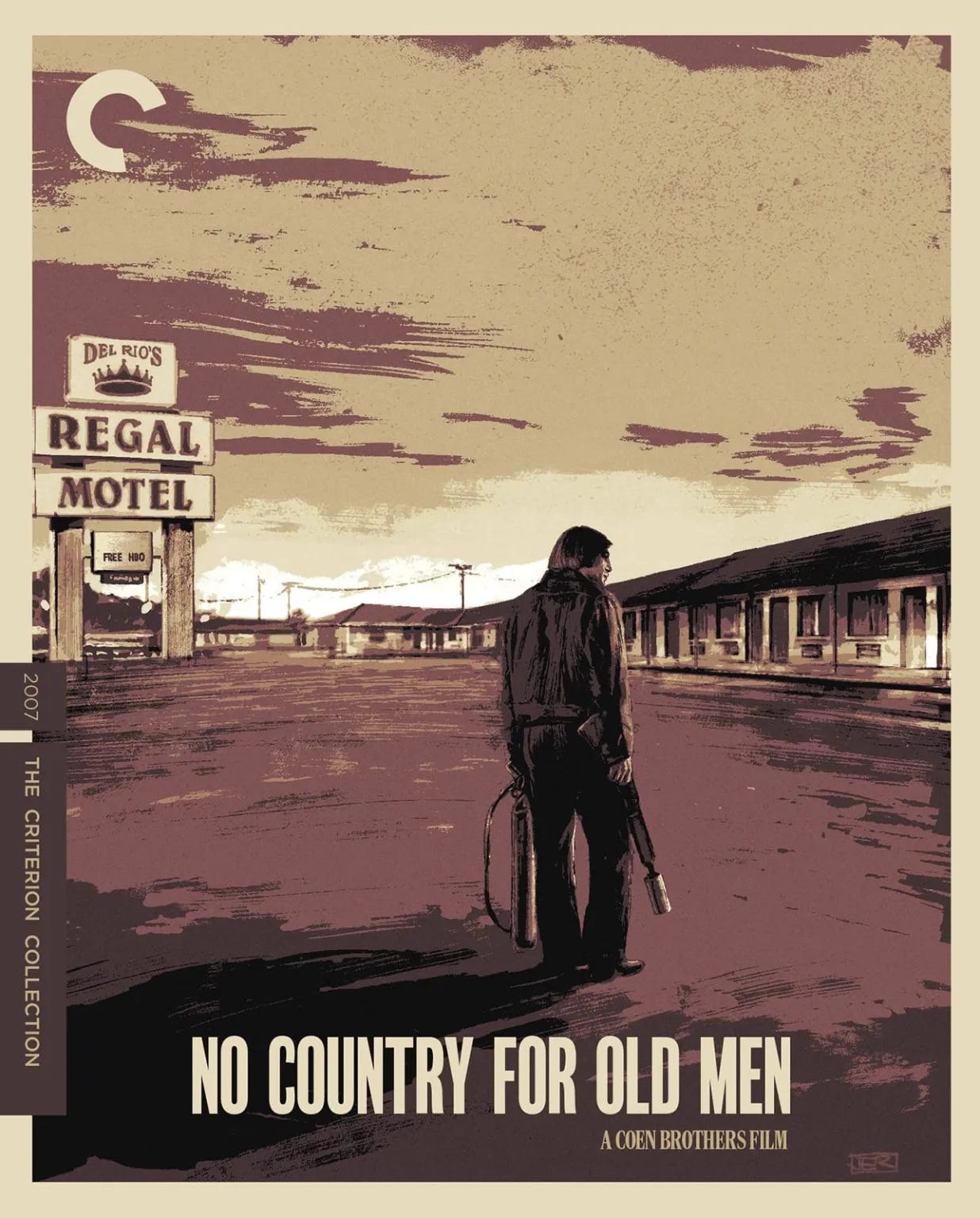
The man who wields the steer-killer is named Anton Chigurh. He is the villain in No Country for Old Men, the 2007 masterpiece written and directed by the Coen brothers, based on Cormac McCarthy’s novel of the same name.
He is played by Javier Bardem, who rightly won an Academy Award for a performance that embodies the old-fashioned meaning of the word “sublime” — what Edmund Burke called the state in which, thanks to a combination of terror and awe, "all [the soul's] motions are suspended, with some degree of horror."
Despite his dead-eyed stare, weird haircut, and boundless contempt for all other living beings, what actually makes Chigurh so “sublime” is not what he does to people, hideous though many of those deeds are. It’s what he believes.
To understand that belief-system, it’s worth examining what is probably the most famous scene in the whole film: Chigurh’s darkly comic exchange with a gas station proprietor (Gene Jones) who, as their conversation progresses, seems to become dimly aware that the stakes for Chigurh’s signature demand — that his victim play a game of heads-or-tails with him — are truly life or death.
Here’s how their conversation progresses:
CHIGURH: What’s the most you ever lost on a coin toss?
PROPRIETOR: Sir?
CHIGURH: The most. You ever lost. On a coin toss.
PROPRIETOR: I don’t know. I couldn’t say.
[Chigurh flips a quarter from the change on the counter and covers it with his hand]
CHIGURH: Call it.
PROPRIETOR: Call it?
CHIGURH: Yes.
PROPRIETOR: For what?
CHIGURH: Just call it.
PROPRIETOR: Well, we need to know what we’re calling it for here.
CHIGURH: You need to call it. I can’t call it for you. It wouldn’t be fair.
PROPRIETOR: I didn’t put nothin’ up.
CHIGURH: Yes, you did. You’ve been putting it up your whole life, you just didn’t know it. You know what date is on this coin?
PROPRIETOR: No.
CHIGURH: 1958. It’s been traveling twenty-two years to get here. And now it’s here. And it’s either heads or tails. And you have to say. Call it.
PROPRIETOR: Look, I need to know what I stand to win.
CHIGURH: Everything.
PROPRIETOR: How’s that?
CHIGURH: You stand to win everything. Call it.
PROPRIETOR: All right. Heads, then.
[Chigurh removes his hand, revealing the coin is indeed heads]
CHIGURH: Well done.
Chigurh then leaves, and the proprietor closes up his shop — confused, terrified, but conscious that he just survived a brush with a self-appointed Angel of Death.
The key line here is “You’ve been putting it up your whole life, you just didn’t know it.”
It represents Chigurh’s belief that the wisdom he carries, which separates him from everyone else, is that our lives have already been decided. And that he — Chigurh — is merely a kind of cosmic bounty-hunter sent to collect on those unknown but inescapable preexisting debts.
The gas station proprietor is, in Chigurh’s terms, a man who has simply never thought about any of this.
He stumbled into the encounter the way he has stumbled through his whole life — passively, without examination, putting up the wager without knowing he was doing it. “You don't know what you're talking about, do you?” Chigurh sneers.
Chigurh does not respect this man, but he does not particularly despise him, either. No more so than he does any other human being, at least.
Instead, he regards him the same way most of us regard an insect we’ve found where it’s not supposed to be. The proprietor’s life is too meaningless to Chigurh to be anything more than a source of fleeting, sadistic diversion.
“…of what use was the rule?”
Carson Wells (Woody Harrelson) is different.
Wells is a professional killer who has been hired specifically to find and stop Chigurh. He’s familiar with him, too. At one point, when asked how dangerous Chigurh is, he jokes, “Compared to what? The bubonic plague?”
Yet his respect — or perhaps his need to perform bravado — only allows him to go so far. “He’s a psychopathic killer, but so what?” Wells says. “There’s plenty of them around.” He decides to take the contract.
While Wells does a good job of finding the money that Chigurh was originally contracted to retrieve, his attempts to best Chigurh are anticlimactic in the extreme. Their fight is basically over before it’s started, and Chigurh quickly forces Wells, at gunpoint, to join him in a motel room and share a final colloquy.
Brief as their conversation is, it’s the most important exchange in the film in terms of understanding Chigurh’s worldview — because it reveals that what Chigurh finds most threatening, and holds in the greatest contempt, is not an individual rival, per se, but rather anyone who believes in free will.
Here’s their final exchange:
CHIGURH: And you know what’s going to happen now. You should admit your situation. There would be more dignity in it.
WELLS: You go to hell.
CHIGURH: [Chuckles] All right. Let me ask you something. If the rule you followed brought you to this, of what use was the rule?
The line I want you to focus on here is “There would be more dignity in it.” On one level, this is a taunt. He’s playing with Wells just like he played with the gas station proprietor.
But on a deeper level — and this is the level at which the cryptic remark about “the rule you followed brought you to this” is best understood — the charge that Chigurh is leveling against Wells is one he’d likely apply to everyone who does not share his worldview.
Because when Chigurh says “brought you to this” to Wells, he’s saying it while pointing a loaded shotgun at him. By “this” he means “your death.”
And by “the rule,” he doesn’t mean some particular code — Wells is not some anti-Chigurh; Wells is an unapologetic cynical-pragmatist — but rather any code, any rule other than Chigurh’s own.
If every rule or code or belief-system eventually leads to death, Chigurh is suggesting, then of what value are they when compared to that inescapable and immovable finality?
When Chigurh tells Wells there would be “more dignity” in “admit[ting] your situation,” he isn’t simply making reference to the situation in which Wells finds himself — i.e., at the wrong end of a gun — but rather the “situation” of being a relatively powerless individual condemned, at birth, to die.
While I’m sure he’d like to hear Wells admit that he’s been bested, what Chigurh really wants to hear Wells confess is that he was defeated before he began. In that context, by saying “You go to hell,” Wells chooses to die in defiance.
“…the path in front of us is now lit.”
In June 2025, Sam Altman, the CEO of OpenAI, wrote the following:
We are past the event horizon; the takeoff has started ... We do not know how far beyond human-level intelligence we can go, but we are about to find out ... most of the path in front of us is now lit, and the dark areas are receding fast.
Whenever I read this drivel — and, I’m sorry, but that’s what it is: drivel — I’m reminded of something else Hannah Arendt once wrote, again in Origins:
[T]he last century has produced an abundance of ideologies that pretend to be keys to history but are actually nothing but desperate efforts to escape responsibility.
Although Altman is not a murderer, and even though his haircut is (barely) better than the one they saddled Bardem with in No Country for Old Men, I would be lying to you if I said I didn’t recognize profound similarities between the two men’s respective “keys to history,” as well as the way they make their arguments.
Like a utopian cult-leader, Altman’s manipulation is filtered through the language of optimism and faith — seemingly the exact opposite of Chigurh’s grim fatalism.
But in both cases, we have men positing that they have a unique grasp of the nature of the universe and the direction of human history. And at the risk of stating the obvious: This is not a small claim!
In another era, in another culture, this hubristic assertion of having discerned the golden path to the inevitable future would be grounds for charges of heresy or blasphemy. The egomania here is astounding, no less so than that of a character who fancies himself Fate (and/or Death) incarnate.
And in both cases, we are confronted with false prophets who are telling us, albeit in different registers, that human superfluousness is either already true (Chigurh) or inevitable (Altman). In the face of such monstrous certainty, despair would be understandable.
Yet I still see reason for hope. And I find that reason, in part, by remembering how Chigurh’s story in No Country for Old Men ends.
“The coin don’t have no say.”
Chigurh’s final confrontation is not with a killer. It’s with Carla Jean Moss (Kelly Macdonald), the wife of Llewelyn Moss (Josh Brolin) who, because of her husband’s refusal to submit to Chigurh, is fated to be murdered as a kind of posthumous punishment against her husband.
Carla Jean is the strongest and most principled character in the whole story, however, and she greets her death with something even more heroic than Wells’ defiance. She doesn’t just refuse Chigurh — she refutes him.
CARLA JEAN: You don’t have to do this.
CHIGURH: [smiles] People always say the same thing.
CARLA JEAN: What do they say?
CHIGURH: They say, “You don’t have to do this.”
CARLA JEAN: You don’t.
CHIGURH: Okay.
[Chigurh flips a coin and covers it with his hand]
CHIGURH: This is the best I can do. Call it.
CARLA JEAN: I knowed you was crazy when I saw you sitting there. I knowed exactly what was in store for me.
CHIGURH: Call it.
CARLA JEAN: No. I ain’t gonna call it.
CHIGURH: Call it.
CARLA JEAN: The coin don’t have no say. It’s just you.
Unlike every other character who crosses paths with Chigurh, Carla Jean understands that his real power — and his real weakness — is what he believes, and the way that he tries to force all those around him to submit to his philosophy.
And she refuses. When he tells her that people “always” tell him he has agency, that he’s not simply enacting a fate that was written long ago, she doesn’t retreat. She suggests that the reason people “always” say that to him is because it’s true.
Chigurh is not some abstract force; there is no pre-written plan. He is a human being in a contingent world who makes choices, just like anyone else.
The best evidence the film gives us that Carla Jean is not only righteous but right comes immediately thereafter. After killing her, while driving away, Chigurh is t-boned by a driver running a red light. He survives, but he’s terribly wounded and must flee the scene on foot.
In this crucial moment, the randomness and unpredictability of the universe — the very thing he has spent the whole film, and presumably his whole career, trying to dispute — is made undeniably clear. And this, more than anyone killing Chigurh, represents the ultimate abnegation of his philosophy.
Now, I don’t know what metaphorical car-crash is awaiting Greg Brockman or Sam Altman or any of AI’s other high priests. I certainly don’t expect AI to go away. I believe that, as Arvind Narayanan and Sayash Kapoor have argued, it is likely a “normal technology” — which means it will indeed change the world.
But — and this is crucial — it will change the world in ways no one can predict. Contra Altman, the path in front of us is not “lit.” It never is. We will stumble forward, as we always have, in shadow and doubt. But that’s not something to lament. It’s something to celebrate.
The coin don’t have no say. It’s just us.