
The real monster in “Widow's Bay” is guilt
The Apple TV series buries its island in sea hags and satanic rites, but every curse is really an alibi — for the unforgivable thing someone did and would rather call fate.

[Spoilers throughout!]
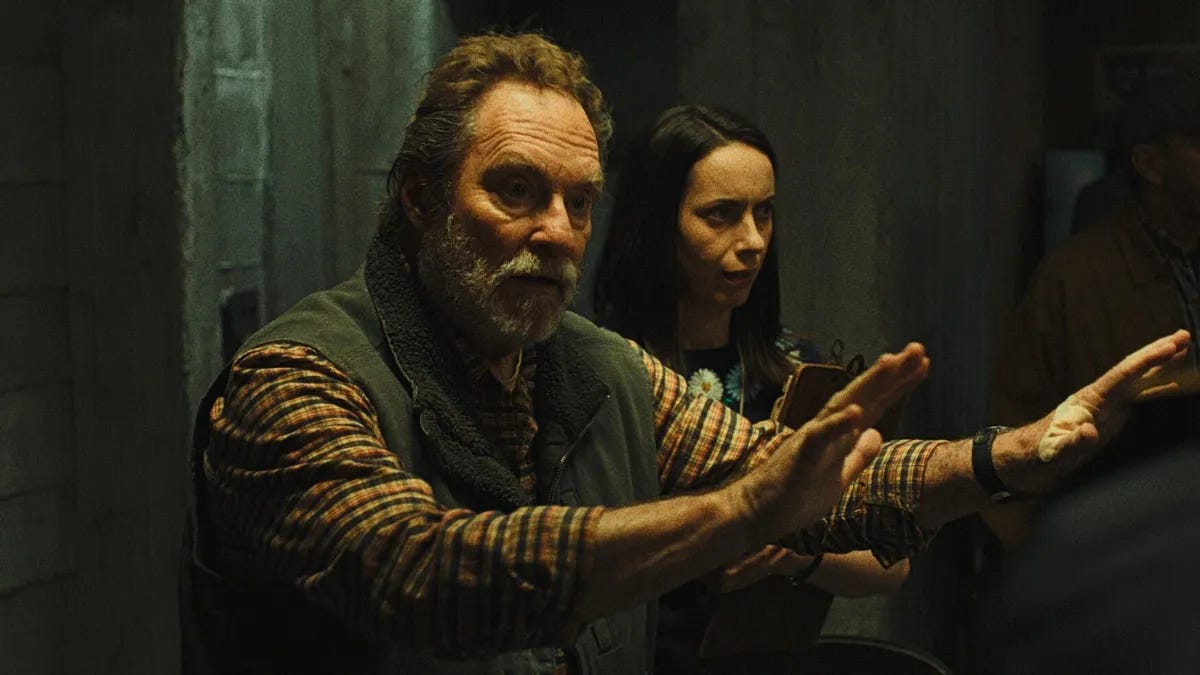
There’s a moment in the seventh episode of Widow’s Bay when Wyck (Stephen Root) — the grizzled old skipper who has spent all season warning anyone who’ll listen that their island is cursed — stops warning and starts admitting.
He shows the town’s mayor, Tom Loftis (Matthew Rhys), a photograph of two teenage boys: himself, and his best friend Mark, the brother of Wyck’s then-girlfriend Gerrie (Nancy Lenehan). Then he shares the story he’s never trusted Loftis enough to tell — a story, one suspects as he tells it, he may have never told anyone before.
They were 16, the island sealed under one of its periodic lockdowns, when they and a few other kids took a boat that wasn’t theirs out past the safe water. Something vast and Lovecraftian came up beneath the hull — all tentacles and appetite — and shattered it, spilling the kids into the black water to drown, be eaten, why not both? Swimming for the surface, Wyck felt a hand close around his ankle: Mark, reaching for the only thing left to hold onto. And Wyck, to save himself, kicked his best friend loose.
Tom tells him it wasn’t his fault, which is both true and asinine (a Tom speciality). Wyck isn’t after absolution. Wyck is trying to make the mayor understand that his lifelong conviction that Widow’s Bay is evil isn’t a crank’s superstition — it’s the story he has built his whole life around to explain the unforgivable thing he did at sixteen. It’s the story that gives his existence structure and meaning.
And if you really listen, the way Wyck is begging Tom to, you can hear the show’s entire argument hiding inside Wyck’s monster story. The thing that has turned Widow’s Bay into a clearinghouse of sea hags and killer clowns and satanic rites isn’t a curse or a demon. It’s guilt.
Reviewing the series for The A.V. Club, Saloni Gajjar praised it for not “succumb[ing] to the trend of making grief its monster” — and she’s exactly right, because the monster here isn’t grief, which is something done to you. The monster here is the thing you did, or failed to do, for which you believe you cannot — and perhaps you should not — ever truly be forgiven.
The terrible debt-collector that is waiting, always waiting, to demand its due — just when you thought you were home-free, just when you can least afford to pay it.
Beneath the show’s spooky and spectacular surface, the supernatural in Widow’s Bay is a decoy; and, as we learned watching the show transform from a Rhys vehicle to a Golden Era HBO-style ensemble piece, for too many residents of Widow’s Bay, it’s an alibi. Every islander who treats as fate the primordial curse, that anyone born on the island will die if they try to leave it, gets to believe their worst moment was written in advance, that nothing they do is ever really a choice.
In the show’s moments of comic relief, Tom rails against his community’s fatalism, complacency, and self-pity — he’s not wrong. (He’s just an asshole.)
This is the show’s sharpest and least fashionable idea. The conventional version of this story — the inherited-trauma register that ran prestige TV for a decade — would locate its wisdom in the naming: surface the buried wound, feel the repressed guilt, sit in that for a moment. But Widow’s Bay complicates this admonition. In ways they’ll joke about and in deeper ways that shape their entire lives, the people of Widow’s Bay know they’re the beneficiaries of an absurdly long history of atrocity and injustice. But that hasn’t brought wisdom. And it hasn’t brought healing, either.
There’s a reason the characters in Widow’s Bay who exude the most moral authority are the ones who carry the heaviest loads and keep choosing anyway.
Patricia (Kate O’Flynn), Tom’s lonely, aggrieved assistant, survived the serial killer who murdered a string of island girls in the ‘90s — despite doing little more than hiding under the bed. This was trauma done to her, but she also carried survivor’s guilt. Why did she live when so many others didn’t? The question doesn’t just haunt her; it’s the main basis for the belief, widespread among those in Widow’s Bay who went to high school with her, that she made the whole thing up.
And yet despite her initial depiction as a thoroughly woke and comically repressed carrier of that flame, Patricia’s character arc resolves in her becoming a survivor who, as one critic’s headline had it, puts every final girl to shame.
Ruth (K Callan) goes further still. In the show’s bravura finale, she reveals ample reason to carry perpetual guilt and grief, but she neither hides from it nor lets it petrify her. First, she forgives herself and finds ways to delight in and support the daughter she never got to raise. Then she carries the story with her not as a dark secret but simply as what it is: a fact of her life, not the meaning of it.
Which brings us back to those poor teenagers and that nightmarish thing in the deep that was waiting for them.
Prophet of ruin that he is, it would be easy to file Wyck with the paralyzed. But look again at what he is actually doing during his disclosure to Tom. For decades, the curse has been his alibi, the great cosmic story that turned a frightened boy’s terrible, human choice — to kick Mark away, to swim for survival, to live — into fate.
But now, and perhaps for the first time, he says the unsayable thing aloud, to a man he has finally chosen to trust. He cannot save Mark. Yet telling the truth is something he does, in the present, of his own free will. A character who was once presented as a walking repository of the island’s many curses and inescapable fates refuses, at last, to let the curse do his living for him.