
The despair of “First Reformed”
How Paul Schrader's masterpiece grapples with "sickness unto death"

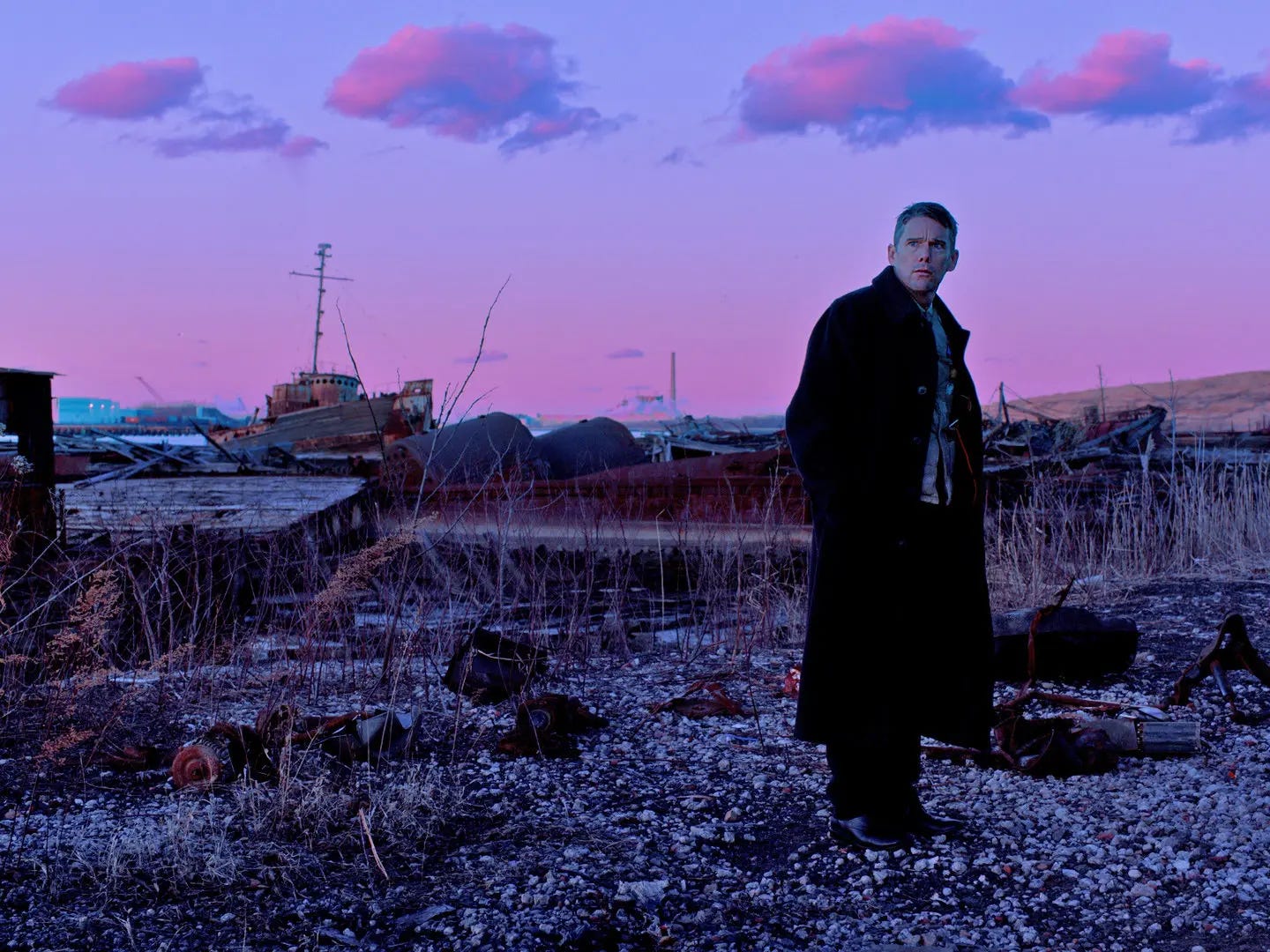
I recently rewatched First Reformed, writer-director Paul Schrader’s 2018 masterpiece about a bitter, self-destructive, and thoroughly hopeless Lutheran Dutch Reform reverend named Ernst Toller (Ethan Hawke) who — supposedly in the name of environmental justice — embraces the logic of violent martyrdom.
I remember the first time I saw the film in theaters I was glued to my seat at the end; I may have even been clichéd enough to mutter “holy shit” once the screen cut to black. But during my most recent rewatch, I realized that, despite the film’s environmentalist trappings, its main themes are intensely personal and psychological, rather than political.
In other words, this isn’t a movie about why someone becomes an environmental terrorist. It’s a movie about how despair — the “sickness unto death,” as Kierkegaard, and Toller himself, calls it — can become an all-consuming force that drives those afflicted with it towards self-destruction for the sake of self-actualization.
Nearly 10 years after it was first released, it was this element of the film that struck me as both most prescient for its time and most important for understanding our own.
And while it would be misleading and mistaken to say the film offers “solutions” or an escape from this spiritual death-trap, I do think it’s fair to argue that by presenting such a psychologically acute (yet merciless) depiction of that “sickness unto death,” he also suggests means of escaping it and finding, if not quite hope, then something that both promises less but offers more.
That something is faith.
Sickness Unto Death
As a starting point for understanding what First Reformed is about and what Schrader is trying to do, it’s important to understand that before the film begins, Toller is already well down the dark path of despair. This is not a story of someone holding onto the edge of faith or reason and losing his grip; this is a story about someone who, when we meet him, is already in free-fall, whether he fully realizes it or not.
Toller’s background is genuinely tragic. He is a reverend and an inheritor, of sorts, of the family business. His father and his grandfather were men of the cloth, and more than that, they were both military chaplains. So was Toller. This is a man who believed in traditional institutions, who saw no distinction between serving God and country. He does not seem to be the kind of person who will embrace the logic of a suicide bomber.
But as we soon learn, recent life has been brutally hard for Toller. Because of his background and family traditions, he tells us, he encouraged his son — despite the passionate objections of his wife — to enlist during the Second Iraq War. Soon thereafter, his son is dead, and because his wife cannot forgive him for encouraging their son to go and die, Toller’s marriage collapses.
Understandably, he can no longer bear to be a military chaplain and leaves the service.
So, by the time we meet him, he is running First Reformed, a small and old church, dating to pre-Revolutionary times, that functions as a tourist attraction for the larger megachurch — Abundant Life — that owns and operates it. While Toller never explicitly complains about his loss of status, the film makes clear that becoming a glorified tour-guide for a megachurch’s loss-leader has wrecked his self-esteem and bred resentment.
Wrestling With God
From the very beginning of the film, it’s clear that these traumas — both personal and professional — have caused Toller to retreat into himself. While he is polite and cordial, good with children and earnest in fulfilling his duties as a tour-guide, he is not a social creature. He does not seem to have friends. His home is dark and barren.
Beyond ruminating (and self-castigating) in a notebook — and drinking to excess every night, despite his self-evidently failing health — it’s unclear what he does with his time. First Reformed isn’t exactly a tourist hot-spot. And only once do we see him engaging in typical pastoral work, feeding the poor. His sermons are usually attended by no more than a handful of people. And when he preaches, he’s going through the motions. In his sermons, the Word sounds hollow.
It is no surprise, then, that when Toller is asked by one of his congregants Mary (Amanda Seyfried) to speak to her increasingly depressed and doom-obsessed husband Michael (Philip Ettinger), an environmental activist who is wracked with rage and guilt about becoming a father in a world he is sure is destined for unfathomable suffering, it is Toller — and not Michael — who comes away from their conversations irrevocably altered.
During the conversation, Toller says all the right things. He even quotes Kierkegaard’s “sickness unto death” formulation when telling Michael that the latter’s despair cannot be reasoned-through; that the only real answer to this “sickness” is faith. And yet when Toller recounts their conversations in his journal, he likens it to the Biblical stories of Jacob wrestling with the Angel (who in many interpretations is understood to have been God).
This means that, to Toller, Michael’s prophecies of environmental collapse, epidemics, refugee chaos, and political dissolution are not the racing thoughts of a deeply depressed person; they’re the word of God. Moreover, whether he realizes it or not, by putting himself in the position of Jacob — who, after his struggle with the Angel, is renamed Israel (which means “contends-with-God”) — Toller is elevating himself into rarefied air indeed.
Toller’s Tragic Flaw
This may seem like a detail, but I believe it’s the heart of the film and the essence of Toller’s tragic folly.
Toller says he is invigorated by their conversation. And the two make plans to speak again. But they never do. Michael asks Toller to meet him at a park. Toller arrives, only to find Michael’s body. He’s committed suicide — violently, gruesomely — and evidently wants Toller to be the first one to find his body. Once again, in a sense, Toller has failed to save a (surrogate) son.
From this point onwards, Toller’s slow decline becomes a free-fall. Toller takes Michael’s laptop (as well as a suicide-bomber vest that Mary finds Michael hiding in their garage) back to his own home. Instead of disposing of either, he immerses himself in the mental world Michael inhabited before taking his own life. He admires the vest. He reads all of the stories Michael has printed or saved on his computer about environmental catastrophe.
He begins to drink more. He withdraws into himself even further. He becomes increasingly obsessed with Edward Balq, an industrialist and polluter who bankrolls Abundant Life — and, by extension, First Reformed — and begins to fantasize about donning the “armor of God” in order to kill Balq and avenge the crimes against Nature (and by extension God) that fuel his business empire. His contempt, for the fallen world around him and for his own inability to strike a blow against it, curdles and deepens.
Mary And Esther
Yet as dangerous as this all is, Toller is not on some inexorable path to self-destruction. First Reformed is not a Greek tragedy. There is no fate. Indeed, the idea that there is fate — that the future is fixed, knowable, and inescapable — is at the heart of despair, the great villain of the film. Rather than some cosmic conspiracy against him, Toller’s real problem is himself.
We see this most obviously in the way Toller treats the two main women characters — Mary (the widowed congregant) and Esther (his former lover). With Mary, Toller gets to pretend to be the person he wants to be. The perfect reverend. A source of benign but uncontested authority. Benevolent, patriarchal, but always at a level of remove. Mary doesn’t know the real Toller. She knows the Toller she wants to see — and, crucially, the version she wants to see is the version he wants to be.
Esther is a much different story.
While Toller tells her that he does not regret their sexual liaison — he says he has seen enough sin to know that what they did together was no such thing —as the film progresses, he treats her with increasing viciousness. He tells her that he finds her concern for him, her desire for him to allow himself to experience happiness and joy, to be burdensome. He seethes at her that she reminds him of everything he wishes he were but is not.
“I despise you,” he sneers. “I despise what you bring out in me. Your concerns are petty. You are a stumbling block.”
I think the key line there is the final one: “You are a stumbling block.” By this point, it’s clear, Toller has given up on the idea of his life being something more than his own. Esther’s supposedly “petty” worries are that Toller seeks medical treatment, that he allows himself to experience love, that he forgives himself for his past enough to believe he deserves a happier future.
Only someone who has decided their life is worth both less and more than a “regular” person could possibly regard any of these issues as “petty.” But that is very much who Toller has become. Battered and bruised as his ego and identity have become, simply being a human being — just one person, more or less like any other — is something Toller simultaneously believes he doesn’t deserve and deserves more than.
As a therapist once told someone close to me: “You know, believing you’re the worst person in the world is, in some ways, not that different from believing you’re the best.” And that is the trap within which Toller has locked himself.
The Gift Of Grace
While Toller does not end up committing murder-suicide, it would be wrong to say that he escapes this prison.
The film’s ending is intentionally ambiguous, and Schrader has said he considered three different conclusions. The one he went with — and thank God he did, because it’s the reason that, as I said earlier, the film left me with that “holy shit” feeling when I first saw it — involves Toller giving up on his plan to don the “armor of God” (a suicide vest) and, it seems, choosing instead to commit suicide.
Fully embodying his messianism as well as his self-loathing, he puts on his own version of a crown of thorns by wrapping barbed wire around his naked torso, and then, it seems, he decides to drink a glass full of Drano. (Another Christ reference, although Toller, unlike Jesus, does not ask God to “let this cup pass from me.”) He won’t kill anyone; but he refuses to save himself.
What we see next, however, is that right when Toller is going to gulp down the poison, Mary somehow confronts him in his home — even though the doors are locked and no one knows where he is — and the two embrace and kiss while the camera circles them before a hard cut to black.
Whether this is actually happening is something Schrader has said he wanted to leave unclear. Perhaps, somehow, Mary gets to him before he drinks the poison chalice; perhaps, instead, what we are seeing is a hallucination — maybe even a moment of grace being given to him by God — before his expiration.
Whatever is “actually” happening (which seems rather irrelevant to me), though, what we are seeing is Toller finally embracing — or, to further the metaphor of grace, perhaps it’s better to say he is being given, rather than he is embracing — the simple and transcendent pleasures of love that he has so assiduously denied himself throughout the film. Whether faith is earned or given is, of course, something that theologians have argued about for centuries.
What First Reformed makes clear, however, is that the question is, ultimately, an academic one. Whether Toller finds faith or whether it is given to him, the point is that, after spending the entire film falling deeper and deeper into the sandtrap of despair — that “sickness unto death” — Toller’s story ends with faith.
The environment is still dying, the world is still fallen, his son is still dead; but for at least one fleeting moment, Toller is able to forget himself long enough to let God in.