
Ross Douthat's complicit mind
President Trump attacked the Pope for opposing war. The NYT's in-house Catholic intellectual says that, actually, this is all very complicated.

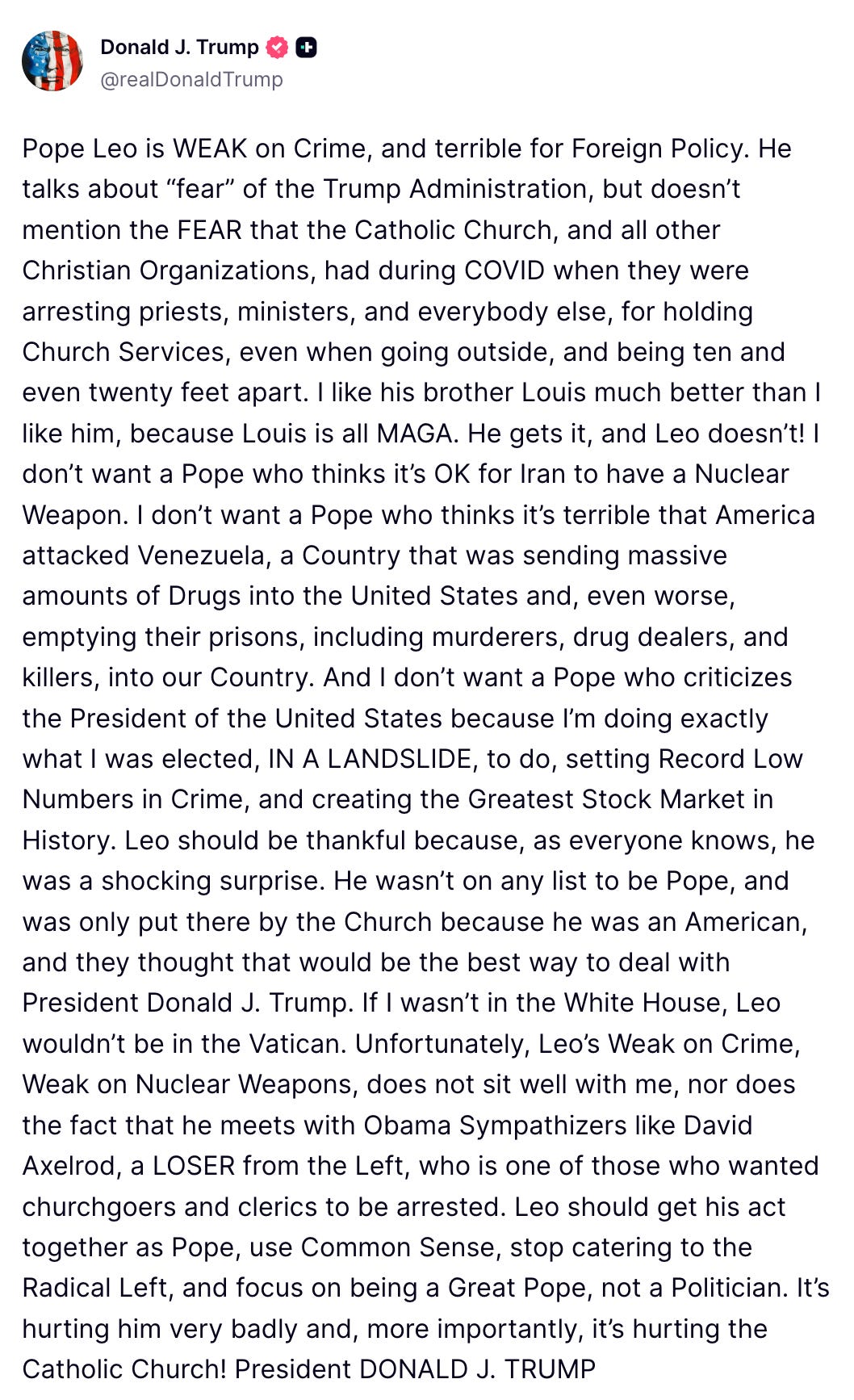
This week, Donald Trump posted an AI-generated image of himself as Jesus Christ. This followed an Easter Sunday post threatening genocide, and a separate post on April 12 in which he railed against the Pope for, among other sins, being “WEAK” on “Crime.”
If you're unfamiliar with Ross Douthat's work, you might have expected the Times' in-house Catholic intellectual to offer a spirited defense of his beloved Mother Church. If you've read him before, you can probably guess what he did instead.
Rather than address the issue head-on, Douthat wrote a meandering column titled “Trump’s Blasphemy Is a Warning.” The take-away, as so often is the case when Douthat feels he has to defend the indefensible, is to reassure his rightwing Catholic readers that they had permission to do — well, effectively nothing.
Like a squid who, feeling cornered, releases a cloud of ink to confuse and overwhelm an enemy before the latter can realize its prey has scuttled to safety, Douthat does not tackle the issue directly but asks the reader to admire an intellectual abstraction, claiming that the best way to understand what’s happening is to think about three “concentric circles” of argumentation.
And like a salesman who first numbs and bores you into lowering your defenses through verbose inanities before moving to the hard-sell, Douthat says that before we can assess whether Trump’s behavior is cause for outrage or political action, we must first traverse “from the general realities of Catholic politics to the intense specifics of this case.”
First, the Vatican has its own political biases and conservative Catholics have legitimate grievances; second, the administration hasn’t made a coherent just-war case for the Iran war; third, Trump’s statements are blasphemy — “outright profanation and sacrilege” — but their true significance is that they are a “warning for his religious supporters about potential conclusions to the story.”
If you haven’t zoned out and begun skim-reading — or perhaps especially if you have — this all sounds reasonable. Very high-minded. So erudite.
But taken together, the cumulative effect is to ensure that by the time Douthat reaches his finale, the reader has been so thoroughly prepared to see the Vatican as compromised — and Trump’s attacks on it as the result of a complicated dispute — that the conclusion can only be personal or spiritual, not political.
The blasphemy is a “warning” to Trump’s religious supporters about “spiritual peril,” Douthat writes. So what is to be done? The action implied is not opposition, but reflection. Don’t disown Trump. Don’t castigate him.
Just stroke your beard, maybe ruefully shake your head, and tut-tut at the messy fallenness of this crazy world. And if you’re worried about how this all may affect you, of course, be sure to pray about it to maintain your own spiritual hygiene.
Embarrassing as this is, Douthat’s sophistry would be easier to dismiss if it were new. It is not.
Indeed, whenever his deep-seated Republican partisanship puts him in a position where he must either break with his faction or defend the indefensible, Douthat retreats into this kind of pseudo-intellectual abstraction. Why say what you mean when you can hit your quota with a low-risk glorified book report?
In July 2024, for example, the day after the assassination attempt on Trump in Butler, Pennsylvania, Douthat published “Man of Destiny,” which declared Trump “a figure touched by the gods of fortune in a way that transcends the normal rules of politics.” The column opened with a Douthat standby — a performance of intellectual responsibility:
Every act of political violence yields instant reactions that can’t be supported by the available facts. A single assassination attempt by a loner with a rifle doesn’t necessarily tell us anything about whether America is poised to plunge into a political abyss.
Again, all of this “to be sure” hedging was essentially a feint. What it licensed was a prominent columnist at the Times declaring Trump a figure touched by the gods — an argument that, without the Hegel, would have been indistinguishable from something posted on Truth Social.
Here, after all, is where Douthat’s argument landed:
For Hegel the great man’s role is a fundamentally progressive one. He is developing or revealing some heretofore hidden truth, pushing civilization toward its next stage of development, sometimes committing crimes or trampling sacred things but always in service to a higher aim, the unfolding intentions of a divine process.
[…]
But what if progress isn’t linear … What if an era is decadent rather than vital? What if there is no obvious next political stage for a civilization’s development? What if stagnation and repetition rule the day? What does a man of destiny look like then?I think we have to say it looks like Donald Trump: a man of notable charisma, limited ideological conviction and naked appetite, motivated as much by wounded vanity as by Napoleonic ambition, who has become the avatar of the rebellious populism that has remade his era’s politics and overthrown or undermined its establishments.
I remember at the time how much this column struck me as a near-perfect illustration of the cowardice and corruption that Czesław Miłosz identified in The Captive Mind, his 1951 analysis of how intellectuals throughout the Eastern Bloc sold their souls for the sake of becoming valued members of the new Stalinist order.
But it wasn’t until Douthat’s latest missive about the Pope that I realized who, in particular, he reminded me of.
It's a character Miłosz calls Alpha — drawn from the Polish Catholic novelist Jerzy Andrzejewski — who before the war had built a reputation as a serious moral writer, and who during the occupation had behaved with genuine courage.
Once the Soviets took over, however, Alpha maneuvered himself into a position of influence under the Stalinist government, writing work that served the Party's needs while maintaining the tone of a man above such tawdry considerations:
The Party confided to him, as a former Catholic, the function of making speeches against the policy of the Vatican. Shortly thereafter, he was invited to Moscow, and on his return he published a book about the “Soviet man.”
According to Miłosz, Alpha’s intellectual degradation took on a specific form — one that, perhaps, could be described as existing within “concentric circles”:
One compromise leads to a second and a third until at last, though everything one says may be perfectly logical, it no longer has anything in common with the flesh and blood of living people.
Because I want to be fair, I should say that there are real differences between Alpha and Douthat. Alpha was operating under Stalinism. He did far more than simply what was necessary to survive. He threw himself at the Party and was handsomely rewarded in return.
If Alpha had decided to stand against the new regime, though, he wouldn’t have simply lost the chance to grab at various golden baubles. He would’ve become unemployable — as would members of his family — before being sent into the Gulag system, or worse.
Douthat, meanwhile, does not need to worry about such existential dangers. If he were to damn Trump, he would not find himself out of work, nor would his children discover that their applications to the Ivy League were being denied because they were related to a political undesirable.
I’ll concede that he’d probably have a tougher time getting Trump-aligned guests to agree to join him on his podcast. Heaven forbid.
But this has to do with circumstance, not essence or character. Douthat doesn’t have to self-abnegate to the same degree as Alpha did because Douthat enjoys the enormous luxuries and privileges of being a leading personality for the most influential media outlet in the world.
Which means that what he does instead is a choice.
The Hegel, the just-war theory, the eschatology: these are all nothing more than red herrings, designed to distract you, the reader, from noticing that Douthat isn’t actually saying anything — and that what he is saying is, at best, a kind of incantation to evoke self-satisfied complicity.
Miłosz’s final judgment on Alpha was to wonder whether “some unknown peasant or some minor postal employee should be placed higher in the hierarchy of those who serve humanity than Alpha the moralist.”
I don’t know if Douthat is self-aware enough to recognize himself in this sentence. But I suspect that even if he did, he wouldn’t change. He’d keep writing pieces exactly like these. I doubt Miłosz would expect anything less.